Key Takeaways
- Capsular contracture can harden breasts.
- Breasts may become firm or uneven.
- Imaging can help detect rupture.
If your breast implant seems to be harder than before, or there is some change in appearance or pain in the breast, you should contact your plastic surgeon. A breast that looks deflated or flatter can be a sign of a ruptured saline implant. Any change in the breast could either be due to capsular contracture or rupture, but only a surgeon will know about it.
Symptoms of these two conditions are very similar and it is known that there is the possibility that a silicone implant can break without anything changing at all.
What Is Capsular Contracture?
Following breast implant surgery, your body will create a thin layer of scar tissue around each implant. This is called a capsule and is completely normal and is generally soft.
If this tissue tightens and becomes abnormally firm it can cause capsular contracture.
This means that the implant can become firm and the breast can become distorted.
contracture can occur in one or both breasts and can occur with both saline and silicone implants. It can occur months or years after surgery. While the exact cause is not fully understood, it can be increased by infection, bleeding and/or fluid around your implants.
Symptoms of Capsular Contracture
Symptoms of capsular contracture can range from mild hardness to painful breasts and changes to the appearance of your breasts. Sometimes people will get a gradual onset of symptoms, however sometimes they will become aware of symptoms when they start to feel uncomfortable.
Common symptoms of Capsular contracture are:
- Hardening – Hardness in your breast.
- Pain – Pain, soreness and aching in your breast.
- Appearance – Roundness and distortion of your breasts.
- Implant displacement – Implants sitting higher on your chest wall.
- Asymmetry – One breast looking/feeling different from the other.
These symptoms do not necessarily mean that you have developed capsular contracture. Other issues such as implant rupture, infections, fluid build up can cause changes to your breasts. If you are concerned you should visit a plastic surgeon who will assess the area and decide if any further investigations are necessary.
When Should You See a Surgeon?
If your breast implant feels firmer, your breast has changed shape, has caused new pain or swelling, you should contact your plastic surgeon, as this could be a sign of capsular contracture.
The condition can occur in one or both breasts, and may develop months or even years after your surgery. This means that whether your implant is newer or older doesn’t matter. You won’t be able to confirm what is causing your symptoms, however if your implant has ruptured this can cause similar changes.
Understanding the Baker Grades of Capsular Contracture
A plastic surgeon will use a grading system known as the Baker grading scale to help explain the severity of the capsular contracture. There are 4 grades which can be used to describe how the breast feels and looks:
|
Grade |
Feel/ Look of breast |
|
Grade I |
Soft breast with a natural appearance. |
|
Grade II |
Slightly firm with a normal appearance. |
|
Grade III |
Firm breast with an obvious difference in the appearance. |
|
Grade IV |
Hard breast with a distorted appearance. Often painful. |
Grade 1 would be considered to be a normal appearance. The higher grades (III and IV) will be more obvious. If mild you may not require any treatment other than monitoring however if it is more severe then you may require some surgery.
While the Baker scale will help your plastic surgeon understand what condition you have, the correct treatment will depend on your symptoms, examination findings and personal requirements.
How Is Capsular Contracture Treated?
Mild cases (Grade I–II) are often just monitored. When the breast becomes firm, painful or misshapen (Grade III–IV), surgery is usually needed to remove or release the tight scar tissue (capsulectomy or capsulotomy), and the implant may be replaced or removed.Dr. Ramiro Morales will recommend the right option after examining you. If you decide you no longer want implants, learn about breast implant removal in Miami.
Capsular Contracture or Implant Rupture?
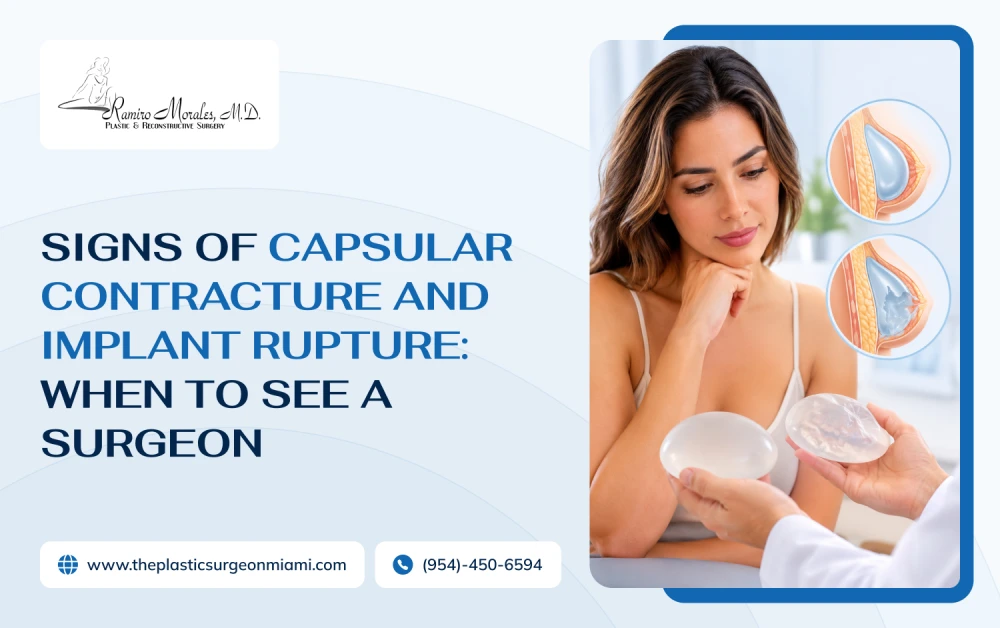
Both can cause firmness, pain or a change in breast shape. A ruptured saline implant usually deflates within hours or days, while a silicone rupture may cause no symptoms and is often found only on ultrasound or MRI. Your surgeon can examine you and order imaging if needed. Read our guide to breast implant ruptures to learn more.
Concerned About Your Breast Implants?
Changes to the shape, size, firmness or comfort of your breasts can indicate capsular contracture or implant rupture. Not all ruptures will be symptomatic.
If you notice any changes or are concerned then please contact The Plastic Surgeon Miami for an assessment. Dr. Ramiro Morales will be able to check your implants and recommend the best course of action. If needed he might recommend a breast implant removal procedure. Book a consultation today.
Frequently Asked Questions
Can capsular contracture go away on its own?
Mild contracture may stay stable and need only monitoring, but moderate to severe contracture rarely improves without treatment.
Does capsular contracture always mean my implants must be removed?
No. Many patients have the scar tissue removed and a new implant placed. Removing the implants entirely is one option, not the only one.
How is capsular contracture diagnosed?
Your surgeon diagnoses it by examining how firm the breast feels and how it looks, using the Baker scale. Imaging may be ordered to rule out rupture.
Can I lower my risk of capsular contracture?
Follow your aftercare instructions, attend follow-up visits and report any new firmness or pain early.